



Dragon Power Meditations Inspiration

Your Personal “Dragon Power”

Giving a hard and fast meaning to any symbol would (in my opinion) be mistake and that is especially true in the case of the dragon. In Western religious mythology, the dragon has come to symbolize something evil and in many instances is considered synonymous with the devil. Yet many Eastern cultures revere the dragon. The symbol is extremely popular in our modern culture as evidenced by its wide appearance in film, art and even on people’s bodies as a sought-after image for tattoos.
My research on the dragon as a symbol has led me to bottom line its meaning as power, pure and simple. Power is an interesting thing; in and of itself power is neutral. Yet its expression can have a helpful or harmful effect on the world, depending on how it is used. For example, electricity is an extremely helpful energy for humanity, yet when electrical wiring becomes faulty, it can cause a house to burst into flames, destroying the house and everything in it.
In my book, “Dancing with your Dragon: The Art of Loving your Unlovable Self,” the dragon symbolizes our personal power. Just like electricity can be helpful or harmful, our personal power can also be used to benefit ourselves and the world, or it can be used in a way that leads to destruction.
Each and every one of us has a degree of personal power. We use this power every day: to get out of bed, go to work, communicate and share with those around us, and to do all that we do from morning to night.

How do you use your Power?

In order to use our power in a way that benefits both others and ourselves, we must become conscious of our motives. We must become aware of why we “do what we do” in any given moment. When we act out of personal need or self-interest, with no thought as to how our actions might affect the well being of others or ourselves, we are operating out of what I call the unconscious dragon. This can easily happen due to the deep personal needs that all of us carry. Our needs for money, sex, love, attention, approval, or even just for a thrill, can drive us to behave in ways that are not for our highest good. Clearly, lying, cheating, misleading, stealing, and destructive forms of violent behavior are actions of an unconscious dragon. But other more subtle types of behavior are reflective of the unconscious dragon as well.
Examples include the following: Choosing to spread a rumor about someone because it gives us a moment in the spotlight with our friends. Making fun of someone at a party or social gathering in order to get a laugh. As women, we might use our sexual energy to manipulate a man into giving us attention, when we clearly know that we don’t intend to sleep with him. Or as a man, we might shower a woman with affection in order to get her into bed, even though we know that it’s just about sex and not about love. And in today’s world, these roles may very well be reversed.

Are you Caught Up in “Giving-to-Get”?

Sometimes our unconscious dragon leads us toward behavior that seems “caring” on the surface, but is actually a means of “giving to get.” In this scenario, instead of taking from people, we give to them. We care for them, or do things for them, all with a hidden motivation of receiving something in return. Although this scenario is not necessarily harmful to the other, it can be difficult for the giver, because many times there is no return on the investment. When we give a lot without getting anything back, it can lead to anger, hurt and resentment–emotional states that are harmful to one’s self.
In “Dancing with your Dragon” the secret to uncovering these deep inner motivations begins with tracking our feelings. Feelings can serve as an “emotional alarm clock” that will wake us up to our unconscious motivations.

Practice Noticing your Feelings

Begin by really paying attention to what’s happening in your feeling world . If you notice that you are feeling angry or hurt, look inside and review the situation that triggered the feelings. Did you give something with an expectation of a return? Was the expectation clearly stated to the other, or something that you believe they should “just know”? Can you let go of the expectation and give without expecting anything in return? If not, you may want to reconsider your decision to “give” to this particular person and simply stop. Or you can choose to practice giving “freely” to them without expectation, which will result in more inner relaxation and peace.

Awareness brings Consciousness

For many of us, emotional challenges arise because we are “unaware” of what’s happening in our own emotional world. Much of what goes on there is subconscious and beneath our level of awareness. At the same time the unconscious behaviors of our “Inner Dragon” have a huge impact on our daily lives and how we experience the world around us. The work I call, “Dancing with your Dragon” is designed to bring this shadow material into the light of understanding where it can be consciously seen, compassionately embraced and lovingly released. With awareness, transformation soon follows leading to new empowered and fulfilling ways of living.

Meditations

A Sitting Meditation for Beginners

Dancing with your Dragon: The Art of Loving your Unlovable Self

There are many forms of meditation that involve moving, shaking, catharsis, dancing, chanting and other ways to disengage yourself from the mental world of the “thought train” by focusing your attention in either the physical, or emotional worlds. These are also helpful practices and I address some of them elsewhere, but this particular exercise is designed to help you develop your ability to become consciously aware of your thoughts while expanding the part of you that can see your thoughts, but is separate from them. This type of meditation leads to what is called “the witness” or “witness consciousness” in a variety of spiritual teachings.
I was first introduced to meditation in the mid-‘70s and have been practicing various forms of meditation since then. Meditation is the art of stilling the level of mind that includes superficial thinking and chatter (sometimes known as the monkey mind) so that you can drop into a deeper level of inner awareness and relaxation. In my personal experience, meditation brings you into silence, silence connects you with spirit, and spirit brings peace, a feeling of oneness and a deep connection with all that is.
One dictionary definition of meditation is to think deeply on a subject, but I prefer to use the word contemplation to describe a practice that involves thinking. For me meditation is the art of “no-thinking.” In order to understand “no-thinking” it’s important to become consciously aware of the constant “train of thoughts” that tends to pull our consciousness this way and that way on a moment-to-moment basis. The thought process will often go something like this: “ Wish I didn’t have to work this morning. Where are my gray slacks? I liked those pants Sue was wearing yesterday. What was that movie she told me about? The popcorn at the theater was so salty last time. I’m hungry. I really need to go to the dentist again. He’s so expensive. I wish I had a better job. And on and on and on.” These types of “thought trains” consume huge amounts of our energy on a daily basis. But with practice, you can learn to distinguish your inner field of awareness from the thoughts that are moving through that field and begin to choose where you want to focus your attention and your power in any given moment. You can choose silence, peace and relaxation rather than worry, anger, frustration, resentment or even mindless chatter. Your body, mind and spirit will thank you for the choice.
You can practice meditating anytime, but it’s said to be easiest first thing in the morning or right before you go to bed at night. If you find yourself waking up in the middle of the night, meditation can be a restful way to spend some time before going back to sleep. The spiritual realms are said to be easier to access during the wee hours, and I find the hours between 3 AM and 5 AM to be a wonderful time to meditate. But of course the most important thing is to choose a time that works for you and to practice regularly.
It’s helpful to read the instructions all the way through at least once before trying them.

Find a place and time where you won’t be disturbed for at least fifteen minutes.

Eventually your body will know intuitively when fifteen minutes is up, but in the beginning it’s useful to set a timer so that your mind can relax about the passage of time. Longer meditations are fine, but fifteen minutes should be the minimum.
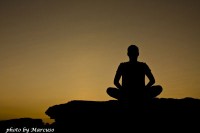
Sit in a comfortable position with your back straight and your spine erect. If you are comfortable sitting cross-legged, you’ll find it to be a helpful position for keeping your spine straight. If not, sit in a straight back chair with your feet flat on the floor. If possible use your own muscles to hold yourself up straight without resting on the back of the chair.
Place your hands in your lap close to your belly, palms facing up with one hand resting on top of the other (place the one on top that feels the best) and the tips of your thumbs touching to create a circle above your palms. (This hand position, known as a “mudra,” is just one of many that you can use while meditating. I find it to be the most relaxing.)

Ask that you be surrounded and protected by the blue light of peace.

Now you will begin to intentionally relax your body. Start by placing your attention in your feet and internally saying the words, “My feet are relaxing now.” Then move up and repeat the process in your calves, knees, thighs, buttocks, lower back, stomach, mid-back, hands, wrists, forearms, upper arms, chest, neck, face, ears, back of your head and top of your head. You may notice that different parts of your body begin to tingle as you invite them to relax. If you don’t notice anything, that is fine too.
From this point, for the next fifteen minutes your job is to simply be awake and alert to what is happening inside of you. You are to watch and notice without judgment, expectation or condemnation. Just watch. There are many ways to do this. I’m going to offer a few possibilities and you can choose the ones that you find easiest and most beneficial.
Become aware of your breath as it enters your nostrils. Stay with it as it moves into your lungs and down through your body. Stay with it as it turns around and becomes an out breath. When ever your mind wanders simply bring your attention back to your breath.
As you breathe, hold your attention at the area between and slightly above your two eyebrows. This is known as the Ajna Chakra or the third eye. If your mind wanders, simply bring your attention back to this point. Do it over and over again.
Watch your thoughts. Become aware of the thought train that is happening in your mind without actually getting on the train. Notice the gap that happens between each individual thought. Allow your consciousness to fall into the gap.
Place your attention in the center of your spinal cord and feel your breath moving up and down within it. Feel yourself becoming light. If your mind wanders, gently bring it back.
Just sit quietly and notice what’s happening inside. Become conscious of the thoughts and feelings that arise within when you make no effort to control them. Don’t energize any of the thoughts and feelings. Just notice them, like you are watching clouds in the sky. You recognize their shape and then wait for the next cloud.

Inspirational Quotes and Talks

The Art of Divine Surrender: An Inspirational Talk by Shaeri. Part I

Inspiration and breath are siblings of the soul. If you want to be inspired, take a deep breath.

No matter what your day may bring, gracious acceptance of the moment will lead you to inner peace.

Revenge perpetuates problems, forgiveness resolves them.

The Art of Divine Surrender: An Inspirational Talk by Shaeri. Part II

Our thoughts affect our feelings. Choose your thoughts wisely.

The heart has wings! Let yourself soar.

When you manage to let go of the old, you open a space to bring in the new. Just breathe and let it go.

If your thoughts are bringing you down, stop thinking. Silence is the doorway to the Divine.

Divinity bathes the soul and the soul bathes the heart. Take a dip in your heart.

Unconditional love is a frequency of the heart, playing love and compassion all day long. Tune it in and dance.

Becoming the Child that Holds the Key to Heaven: An Inspirational Talk by Shaeri.

Thoughts create feelings. When feeling bad about yourself, notice what you’re thinking and change the thought.

An authentic smile is like a blessing, it reaches out and touches the soul.

Every moment is rich with life. Let the fullness arise within and satisfaction will soon follow.

An open heart is a vehicle for the soul. Trust carries the key.

Divine unconditional love is available for us anytime, anyplace. The love never leaves us, we just forget that it’s there.

Awakening to the Divine warms the soul, just as the rising sun warms the heart.